 Ryan Malloy
86a5db5b08
Ryan Malloy
86a5db5b08
Rewire GPIO↔HMC472A so GPIO(n) = step bit (n-1):
  GPIO1→V6(0.5dB), GPIO2→V5(1dB), ... GPIO6→V1(16dB)

This enables single-instruction GPIO updates:
  GPIO.out_w1tc = (step & 0x3F) << 1
  GPIO.out_w1ts = (~step) & 0x7E

Replaces 28-line loop with 4-line bitwise code.
5.6 KiB
HMC472A Attenuator Controller Wiring
Connection Diagram
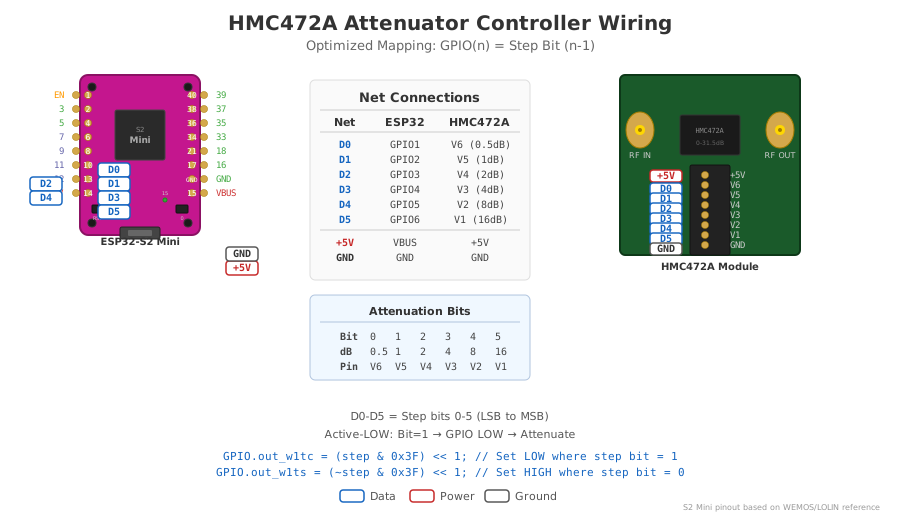
Pin Mapping (Optimized for Bitwise Ops)
The wiring is arranged so GPIO number = step bit position + 1, enabling single-instruction bitwise operations in firmware.
| ESP32-S2 Mini | HMC472A Module | Step Bit | Attenuation |
|---|---|---|---|
| GPIO1 | V6 | Bit 0 (LSB) | 0.5 dB |
| GPIO2 | V5 | Bit 1 | 1 dB |
| GPIO3 | V4 | Bit 2 | 2 dB |
| GPIO4 | V3 | Bit 3 | 4 dB |
| GPIO5 | V2 | Bit 4 | 8 dB |
| GPIO6 | V1 | Bit 5 (MSB) | 16 dB |
| 5V (VBUS) | +5V | — | Power |
| GND | GND | — | Ground |
Why This Mapping?
// Old approach (loop required):
for (int i = 0; i < 6; i++) {
    pin = ATTEN_PINS[5-i];  // Reverse mapping
    if (step & (1 << i)) set_low(pin);
}

// New approach (pure bitwise):
GPIO.out_w1tc = (step & 0x3F) << 1;           // Set LOW where step=1
GPIO.out_w1ts = (~step & 0x3F) << 1 & 0x7E;   // Set HIGH where step=0
The step value bits map directly to GPIO register positions. No loop, no lookup table.
HMC472A Module Header Pinout
The 8-pin header on the HMC472A module (top to bottom when viewing from component side):
| Pin | Signal | ESP32 GPIO | Description |
|---|---|---|---|
| 1 | +5V | 5V VBUS | Power supply (+5V DC) |
| 2 | V6 | GPIO1 | 0.5 dB (step bit 0, LSB) |
| 3 | V5 | GPIO2 | 1 dB (step bit 1) |
| 4 | V4 | GPIO3 | 2 dB (step bit 2) |
| 5 | V3 | GPIO4 | 4 dB (step bit 3) |
| 6 | V2 | GPIO5 | 8 dB (step bit 4) |
| 7 | V1 | GPIO6 | 16 dB (step bit 5, MSB) |
| 8 | GND | GND | Ground |
Logic Levels
Active-LOW control:
- LOW (0V) = Attenuate (apply the dB value)
- HIGH (3.3V or 5V) = Pass (0 dB contribution)
The HMC472A accepts 0–5V TTL/CMOS logic. The ESP32-S2's 3.3V GPIO output is fully compatible.
Attenuation Examples
| Step | Binary | GPIO State (1-6) | Total Attenuation |
|---|---|---|---|
| 0 | 0b000000 |
HHHHHH |
0 dB |
| 1 | 0b000001 |
LHHHHH |
0.5 dB |
| 5 | 0b000101 |
LHLHHH |
2.5 dB |
| 31 | 0b011111 |
LLLLLH |
15.5 dB |
| 63 | 0b111111 |
LLLLLL |
31.5 dB |
Formula: attenuation = step × 0.5 dB where step = 0–63
Wiring Diagram (Text)
ESP32-S2 Mini                    HMC472A Module
   (Left Header)                   (8-pin Header)

        3V3 ─┤ 1                   ┌─────┐
   ──────────────────────────────┐ │ +5V │← 1
     GPIO1 ─┤ 2 ───────────────────│ V6  │← 2  (0.5 dB)
     GPIO2 ─┤ 3 ───────────────────│ V5  │← 3  (1 dB)
     GPIO3 ─┤ 4 ───────────────────│ V4  │← 4  (2 dB)
     GPIO4 ─┤ 5 ───────────────────│ V3  │← 5  (4 dB)
     GPIO5 ─┤ 6 ───────────────────│ V2  │← 6  (8 dB)
     GPIO6 ─┤ 7 ───────────────────│ V1  │← 7  (16 dB)
        GND ─┤ 8 ───────────────────│ GND │← 8
                                   └─────┘
   (Right Header)
         5V ─┤ 16 ─────────────────┘ (to +5V)
Note: The diagram shows straight-through wiring (no crossovers) because the optimized mapping aligns GPIO numbers with the module header in reverse order.
ESP32-S2 Mini Physical Pinout
          ┌─────────────────┐
          │     USB-C       │
          └─────────────────┘
     3V3 ─┤ 1            16 ├─ 5V (VBUS) ──► +5V
  GPIO1 ─┤ 2            15 ├─ GPIO15 (LED)    │
  GPIO2 ─┤ 3            14 ├─ GPIO14          │
  GPIO3 ─┤ 4            13 ├─ GPIO13          │
  GPIO4 ─┤ 5            12 ├─ GPIO12          │
  GPIO5 ─┤ 6            11 ├─ GPIO11          │
  GPIO6 ─┤ 7            10 ├─ GPIO10          │
     GND ─┤ 8             9 ├─ GPIO9          │
          └─────────────────┘                 │
            ↓   ↓   ↓   ↓   ↓   ↓             │
           V6  V5  V4  V3  V2  V1 ◄───────────┘
           (HMC472A control pins + power)
GPIOs 1–6 are on the left header, pins 2–7. Direct ribbon cable from S2 Mini left header to HMC472A control header (reversed).
KiCad Schematic
A full KiCad schematic is available at hmc472-controller.kicad_sch for detailed EDA work.
Notes
- No level shifting required — ESP32-S2 3.3V GPIO drives HMC472A directly
- Boot state — GPIOs default HIGH at boot = 0 dB attenuation (safe)
- Glitch-free switching — Firmware uses register-level writes (
GPIO.out_w1ts/GPIO.out_w1tc) - Power — The S2 Mini's 5V pin sources USB VBUS directly, sufficient for HMC472A's 2.5 mA draw
- Bitwise optimization — GPIO = bit + 1 mapping eliminates loop in firmware